Exhibitions
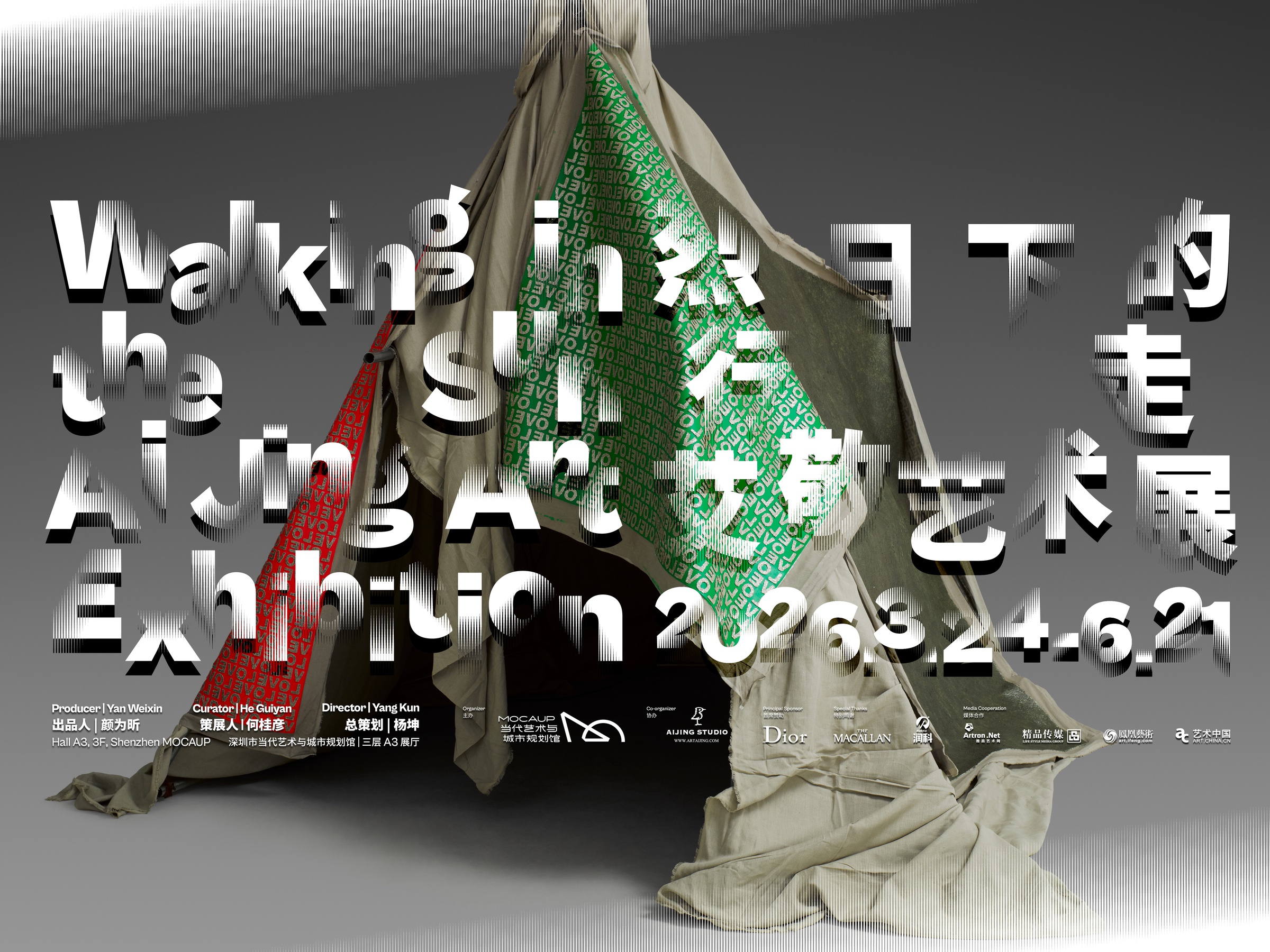
Walking in the Sun — Ai Jing Art Exhibition 2026
"The phrase Walking in the Sun was inspired by a work by Foucault. Its general idea is this: all questions may find their answers through walking in the sun."
— Ai Jing
*The exhibition consists of three sections, an artist timeline, and a thematic short film.
Section One: My Mom and My Hometown
Introduction
"Everyone is able to find in the history of his homeland something that will forever make him proud. To understand and preserve these precious things is the inescapable responsibility of every individual."
— Jacob Burckhardt
The works in this gallery begin with personal narrative: my mother, my hometown, and the memories of childhood—the open fields where I once played, the running as I chased dragonflies, the closeness to nature, and those memories of color and light. The works Girl and Swing and My Mom and My Hometown are important pieces and threads within this constellation of memory.
The other works form a collection of major pieces that have been shown in my solo exhibitions both in China and abroad over the past decade or so, including the I Love Color series, the Mr. R series, and the Walking in the Sun series. Also included is the installation My Hometown, which was shown in my 2012 solo exhibition I LOVE AIJING at the National Museum of China. It is a video work reinstalled in a discarded boiler once used in our studio, recording the everyday life of my parents as well as the process through which they helped me complete the installation My Mom and My Hometown. The installation The Story of Yanfen Street was previously exhibited in 2014 in my solo exhibition Ai Jing's Love at the China Art Museum in Shanghai. Inside this Beijing-brand television set produced in the 1960s, the image of a little girl standing in front of her home and singing is none other than my childhood self.
At the end of this section, we push these emotional narratives toward a "climax." These emotional narratives, together with the memories of childhood, have already taken shape as a presentation of color. Black soil transported from Northeast China is spread across the walls of the exhibition space, while the I Love Color works hanging there project memories of the Northeast through the light and shadow of "the setting sun"—my hometown, cornfields, labor, and harvest.
The I Love Color series is built upon the repeated writing, smearing, and layering of the word "LOVE." It is the only series that I have continued to cultivate deeply over a long period of time.
From this series emerged several other bodies of paintings, such as the Mr. R series and the Walking in the Sun series. Within this endless repetition, almost like chanting sutras every day, what appears monotonous does not bring me boredom, but rather constant new discoveries and possibilities, almost in the way that "One gives birth to Two, Two gives birth to Three, and Three gives birth to all things." What this process of practice has brought me is the experience of cycles and recurrence, overturning and rebuilding, fear and anticipation toward the unknown, and the formation and deepening of courage.
The video work My Mom and My Hometown was filmed in 2012, and was first presented in my solo exhibition at the National Museum of China. In this 25-minute documentary, the Shenyang of that time is faithfully recorded. My mother led my second and youngest aunts, our neighbors, my elementary and middle school classmates, and their family members—a total of fifty-four relatives and friends—to take part in the weaving process. They unraveled and washed old sweaters, wool pants, scarves, and gloves from their homes, and then knitted them into brightly colored fabric pieces marked with the LOVE symbol. These knitted pieces were then stitched together into a tapestry more than sixteen meters long and over six meters wide. The film records that unforgettable scene of collective labor: the mothers working tirelessly, my father shopping and cooking, and our two little dogs at the time, Huanhuan and Lele, keeping us company… On the land of Northeast China, it is because people have faith, warmth, and feeling that they are able, time and again, to endure the bitter winter and make their way into spring.
This is a quality of diligence and resilience worthy of our praise. It also allowed me to see how extraordinarily receptive people from the Northeast are to new ideas and new ways of thinking.
The passion in Northeastern people can be ignited very easily. Handcraft is part of the inherited fabric of our generations, and this was also a successful instance of traditional craft being advanced through a new set of ideas.
Now, more than ten years later, many of the people in the documentary have passed away.
My mother, too, left us forever in 2015. We miss her deeply.
Section Two: The Power of Flowers
Introduction
"Regenerative humanism is built upon the recognition of human complexity. It acknowledges the full qualities and complete rights of all human beings, regardless of their origin, gender, or age. It arises from ethics, namely solidarity and responsibility. It constitutes a planetary humanism of Earth-as-Homeland (embracing all homelands while making them one's own). Regenerative humanism means not only a sense of human community and mutual solidarity, but also a sense of being part of this extraordinary and unknown adventure, and the hope that it will continue to transform, giving birth to an entirely new future."
— Edgar Morin
The creative core of the works in this gallery is love and peace; it is also humanistic care. The overall tone of the gallery transforms the power of nature into reflections on time, space, the age we live in, and the process of walking. The work Flowers Behind Every Door #2 consists of an old pair of Qing-dynasty doors bursting open with flowers pouring forth. These doors were found in an overseas antiques market. They had already been painted blue, and through the mottled traces accumulated by time, they seem to tell us that they too once passed through a mysterious journey.
Guns and Roses originates from a world-famous press photograph by the French photographer Marc Riboud. We reinterpreted the original image through the traditional technique of screen printing, highlighting its texture and materiality. I then covered the entire surface with handwritten "LOVE,” adding a sense of perspective and movement while also giving the work a new interpretation. The inspiration for this flowing handwritten form of "LOVE" dates back to around 2003. At that time, I saw the album of Water Studies by the Southern Song painter Ma Yuan at the Palace Museum in Beijing. That experience of viewing the work has influenced me so deeply that its impact has lasted for more than twenty years. To this day, those rippling images of water continue to flow through my mind—so mysterious, so magnificent, so delicate, so elusive, and yet utterly mesmerizing to me. It was also for this reason that, during the pandemic, I began experimenting with colored-pencil works on paper, including FLOW, which is also included in this exhibition. For many years, the image of Water Studies has seemed to me like the surging passion that has continuously moved through my work: at times vast and rushing without end, at times winding and tender, serene and quiet.
In 2024, I was invited by the French fashion house Dior to create the sculpture The Power of Flowers #1, which was first shown in my solo exhibition ALL WE NEED IS LOVE at Victory Theater in Shanghai. The work was inspired by Monsieur Dior's sister, Catherine Dior. During the Second World War, this remarkable woman was arrested for opposing the war and imprisoned by the Nazis for ten months. Later, she returned to Provence and began cultivating rose gardens, spending her life in the fragrance of nature, and finally passing away in her own flower house in her nineties. This work pays tribute to Catherine and to all great, strong, and courageous women—to the feminine force devoted to love and peace.
This gallery presents the new work The Power of Flowers #2 for the first time. Together with the other two hand sculptures, The Power of Flowers #1 and AI Pray (created in 2015), it forms a triptych of works centered on the hand. I have always admired and cherished my own two hands, and for that reason, these three hand works were all modeled on my own hands. I have noticed that many artists are drawn to making works of hands—Picasso, Rodin, Bourgeois, and so on. The hand seems almost like an artist's second portrait, a part of the body the artist can rely on. It is used to express one's inner self and one's wishes; in that sense, hand and heart become one.
In addition, the gallery will also present a group of woven fiber works made from environmentally friendly bamboo fiber and other natural materials. This series is titled Seeing the Universe—Seeing You, and is derived from enlarged fragments of individual letters from the I Love Color series. By this title, and by what I mean through "Seeing—the Universe," I refer to a kind of belief: a belief accumulated little by little in the process of artistic creation, a way of envisioning the infinite possibilities within one's own practice.
A new installation in this gallery, titled Memory, is composed of fourteen paintings, an old vase, plastic flowers, three sculpted hands, and a number of small stone carvings, such as dragonflies, caterpillars, and ceramic daisies, made from marble, Shoushan stone, and other materials. This is an open "memory," an experience of nature. Perhaps everyone has had something similar. We draw strength from nature, and in sharing this, we hope to inspire viewers to bring their own personal memories into this scene.
Section Three: Walking in the Sun
Introduction
Is it still possible for humanity to find a global, plural narrative—a shared set of assumptions and expectations that can include everyone and be accepted by everyone? For the growing number of migrants in many parts of the world, this is a matter of life and death. "Who are 'we'?" is one of the great political questions of our time, and at its core it is inseparable from what we believe.
— Neil MacGregor
This gallery stays closely aligned with the central theme—walking in the sun. From my hometown of Shenyang, I walked to Beijing, Shanghai, Guangzhou, Shenzhen, and Hong Kong, and then onward to Japan, New York, London, Milan… My footsteps, like those of my ancestors, have been in constant movement—wandering, drifting, searching. I express, communicate, and share what I feel in the course of walking through music and visual art. From the perspective of personal narrative, I have entered the realm of global narrative, and this is an inevitable result of the times in which we live.
Today, across the globe, those displaced by war, those wandering through cities, those living in tents in refugee camps—the issues they reflect go far beyond mere survival. Although we are fortunate to be far from the battlefield, we still feel deeply with them and cannot turn away from the suffering that is taking place.
The new work The Little Girl Sleeping in a Tent was inspired by Anna Rahmoni, photographed by Muhammed Muheisen, a photographer who has won the Pulitzer Prize twice. The little girl sleeps inside a makeshift tent. Between her sweet face and the place of displacement in which she temporarily rests, there emerges a moment of calm, and the world seems once again beautiful and harmonious, as if the war itself had briefly come to a halt… The photographer captured that profoundly moving moment. Through this image, it tells people the meaning of peace. We are deeply grateful to Muhammed Muheisen for granting us permission and agreeing to our mode of reinterpretation, allowing the beautiful intention carried by this work to reach the wider world. And through it, we also wish to tell audiences in China that our hearts remain bound to those who have been devastated by war and suffering.
The Little Girl Sleeping in a Tent employs the same artistic method as Guns and Roses: after completing the screen-printed image, I wrote "LOVE" across the entire surface of the picture.
Another new work is an ornate tent titled Beautiful Barrier. The exterior of the work is wrapped in canvas covered all over with the word "LOVE," while inside the sound of ocean waves plays in an endless loop. What this work seeks to convey is that behind this painstakingly constructed "splendor," we still have an opportunity to move closer and go deeper, to feel and contemplate all that is happening here and now, in this moment, today.
In another area of Section Three, the three walls present "LOVE" works in black, gold, and silver-gray respectively. The method of making these works returns to the early period when I first established my studio in New York: minimalist in approach, ordered and restrained. These materials are all mixtures of natural substances—metal powder, mica, and sand. Inscribed on one work is a line by Enheduanna, the first recorded woman poet in human history: "I went towards light, it felt scorching to me."
The new work The Stones is a formation of stones: fragments from an old stone bridge in an ancient town that once bore the footsteps of passersby, through spring and autumn, people coming and going, stories having taken place, and stories still continuing… We arranged these stones into a circle, creating a contemplative field and leaving the work of thought to the viewer.
Walking in the sun is part of our daily lives. Under the light of the sun, we continue onward. The heat we endure is also a test for us. What we see and hear in the course of walking enriches our lives, and the wisdom we gain through walking becomes a source for creation.
References
Living with the Gods: 40000 Years of Peoples, Objects and Beliefs
— Neil MacGregor
Lessons for a Century of Life — Edgar Morin
Reflections on History — Jacob Burckhardt
Aesthetic as Science of Expression and General Linguistics — Benedetto Croce
The Story of Art — E. H. Gombrich
Art and Civilization: Lectures on the History of Western Art — Fan Jingzhong
Special Thanks
Here, please allow me to express my heartfelt gratitude to my mentor, Mr. Fan Jingzhong. Over the years, he has continually offered me guidance and support, given me books, and directed the path of my reading, thereby expanding my opportunities to gain knowledge and giving me another wing with which to fly. My teacher once said, "Knowledge is like another wing.” The theoretical foundation of this exhibition also stems from the many years during which I had the privilege of learning from him.
My sincere thanks go to my curator, Professor He Guiyan, for his trust and support over the years. I would also like to thank Yan Weixin, Director of the "Two Museums,” Yang Kun, Deputy Director, and all the museum colleagues who have supported this exhibition. I would like to thank Associate Professor Tian Bo of the Guangzhou Academy of Fine Arts and his team for the design of the key visual for this exhibition. I thank my team at Ai Jing Studio, as well as my relatives, supporters, and close friends for their precious friendship and companionship.
My heartfelt thanks go to our Principal Sponsor, Dior, for its generous support. Dior has always paid close attention to artistic originality. The founder of the brand, Monsieur Dior, was once engaged in the art trade in his early years, and the artists he represented were later written into art history. In recent years, we have had the honor of maintaining a close collaboration with Dior, and the story of Catherine Dior, Monsieur Dior's sister, has deeply moved us. Dior has also provided great support for the children's public welfare project founded by our studio, "I Love Color – Little Genius Painting Competition.”
We would also like to thank The Macallan Single Malt Scotch Whisky for its generous support. The Macallan has always upheld a spirit of craftsmanship and the pursuit of exceptional quality, creating whiskies renowned for their rich and distinctive character and natural color. Our meeting began with a shared love of art.
Our thanks also go to Guangdong Runke Bioengineering Co., Ltd. for its generous support. Founded in 2000 in Shantou, Guangdong, the company is a national high-tech enterprise specializing in the research and production of microalgae-based nutritional foods and raw materials through modern bioengineering technology. As the first company in China and the second in the world to industrialize microalgae DHA, Runke has participated in the formulation of national standards and helped break foreign technological monopolies. Its algal DHA raw materials rank first in China and among the top three worldwide.
Finally, I would like to thank the educators and artists of the art world, as well as friends from all sectors of society and the media, for their attention and kindness. None of our encounters are accidental. All strength comes from the gifts of nature and from our determination to pursue and explore what is beautiful.
In a recently published book, Living with the Gods, there is a story like this: from one surviving sculpture discovered by humanity, historians concluded that even in an environment where the conditions of human survival were extremely harsh and limited, people still chose an artistic creator from within their community and allowed that person not to engage in hunting or gathering for survival, but simply to devote themselves to making art. This story tells us that at no time has humanity ceased to long for and explore the spiritual world.
I firmly believe that art exists in service to the public; it fulfills the public's pursuit of beauty and imagination. Art is a medium of spiritual exchange with its audience, and it is a shared need of society. Thank you to every viewer who walks into the museum—it is you who make the creation of art more meaningful.
— Ai Jing
March 2026
Curator’s Note
This solo exhibition by Ai Jing consists of three sections, each with its own emphasis yet forming an integrated whole.
The first section, My Mom and My Hometown, takes the trajectory of the artist's childhood as its narrative thread, linking her profound remembrance of her mother with her enduring memories of her hometown, and revisiting the origins of life through diverse artistic expressions.
The second section, The Power of Flowers, centers on the motif of the "flower" as its primary visual vehicle. On the one hand, it expresses a love of nature and a celebration of life; on the other, it speaks to the immense strength embodied in human care and mutual support in times of war and suffering.
The third section, Walking in the Sun, is grounded in the artist's reflection on modernity and globalization. It focuses on the plight of refugees in wartime and on the conditions of individual existence, and, through core themes such as love and devotion, explores the value and meaning of individual life in the present moment.
Although the three sections are relatively independent, their narrative trajectory consistently presents a personal and non-linear character, within which four core keywords and creative threads run throughout.
The first keyword is "personal growth." In the first section, works such as Girl and Swing, The Story of Yanfen Street, and My Mom and My Hometown take childhood memory as their point of departure. They place personal development within the currents of historical change, naturally interweaving personal memory with collective memory, and individual narrative with shared experience, allowing viewers to perceive how reality, imagination, and remembrance are organically integrated within the artist's creative expression.
The second keyword is "cultural nomadism." "Cultural nomadism" is both a cultural condition and a form of identity consciousness. Starting from Shenyang, Ai Jing traveled to Beijing as a singer, and later lived across various parts of the world as a contemporary artist. From Yanfen Street and Tiexi District to Beijing, Hong Kong, Tokyo, and New York, beyond the movement of space and the sedimentation of time, her transregional and cross-cultural life experiences have not only enriched her artistic practice, but have also awakened a heightened awareness of her cultural identity. In fact, embedded within "cultural nomadism" is a subtle psychological distance, as well as an underlying anxiety regarding identity at the level of cultural consciousness. Confronting the tensions constituted by the local and the global, locality and regionality, Ai Jing tends to adopt the cultural perspective of the "Other," breaking free from habitual modes of thought while maintaining a sharp sensitivity and critical awareness toward surrounding realities. This constitutes the original intention and core motivation behind works such as The Stones and Guns and Roses.
The third keyword is "regenerative humanism." This concept was proposed by the French philosopher Edgar Morin, who argues that regenerative humanism is constructed upon an understanding of human complexity. It recognizes the full qualities and equal rights of all individuals, regardless of their origin, gender, or age. It is rooted in ethics, namely solidarity and responsibility. It forms a planetary humanism of the "Earth–Homeland," which regards the Earth as a shared homeland while respecting all individual nations. Regenerative humanism signifies not only a sense of human community and mutual support, but also a sense of being engaged in an extraordinary and unknown journey, with the hope that it will continue to evolve and give birth to an entirely new future. Ai Jing deeply identifies with this philosophy. In the third section of this exhibition, she turns her gaze toward communities displaced by war, and through installations, video, photography, and painting, grounds her practice in a belief in a shared human community, conveying a great love that transcends boundaries of gender, race, geography, and nation.
The fourth keyword is "LOVE" and the power of love. In Ai Jing's works, the force of love emerges from multiple sincere sources: the nurturing warmth of family and close friends; a deep affection for nature and everyday life; resilience in the face of suffering; and the quiet selflessness of ordinary individuals. In works such as The Power of Flowers, Ai Pray, and Beautiful Barrier, viewers can clearly perceive the transmission and resonance of love's strength, and experience the profound humanistic sentiment and spiritual warmth that flow through the works.
The title Walking in the Sun is inspired by the thought of the French philosopher Michel Foucault. Its central implication is that all confusion and questions will ultimately find answers in the act of walking beneath the blazing sun. As the title of this exhibition, on the one hand, it renders concrete Ai Jing's more than twenty years of artistic practice and inner transformation; on the other hand, the "answer" pursued by Foucault, for Ai Jing, resembles more a spiritual quest and inquiry. In the concluding section of the exhibition, viewers may clearly trace the artistic trajectory and intellectual imprints left during her "walking" through the artist's chronology, manuscripts, various video materials, and documentaries. Her deep attachment to her hometown, her profound remembrance of her mother, her fervent invocation of love, and her unwavering devotion to peace not only run through all the works presented in this exhibition, but also constitute the inexhaustible driving force sustaining her continuous creation.
He Guiyan
(Critic and Curator; Professor and Doctoral Supervisor, School of Arts and Humanities, Sichuan Fine Arts Institute)
February 26, 2026
Huxi Campus, Sichuan Fine Arts Institute

-

My Mom and My Hometown
2018 Solo Exhibition at the Industrial Museum of China (Shenyang) 27 Oct 2018 - 27 Jan 2019 On October 27, 2018, Ai Jing will return to her hometown and hold the solo exhibition, “My Mother and My Hometown”, at the Industrial Museum of China, on Weigong street in Tiexi district of Shenyang. Read more -

FLOWERS BEHIND EVERY DOOR
SOLO EXHIBITION AT THE SHENZHEN ART MUSEUM, CURATED BY CHEN LUSHENG 25 Mar - 20 Apr 2018 Contemporary artist Ai Jing solo exhibition 'Flowers Behind Every Door' opened at Shenzhen Art Museum on March 25, 2018 at 4pm The exhibition's curator, researcher at the National Museum of... Read more -

Useless Value
GROUP EXHIBITIONS AT WANYING ART MUSEUM IN SHIJIAZHUANG, CURATED BY LIU CHUN FENG, 24 Dec 2017 - 17 Mar 2018 At the end of the year 2017 Ai Jing created a brand new body of work for the exhibition 'Useless Value' and launched <>series made of old wool and nails... Read more
-

第三届中国西部国际艺术双年展在呼和浩特内蒙古美术馆成功开幕
3 Nov - 15 Dec 2017 第三届中国西部国际艺术双年展于2017年11月3日在呼和浩特市内蒙古美术馆开幕。中国西部国际双年展由艺术家田野于2010年创立策划,是中国西部地区最具学术性与专业性的艺术大展,迄今已成功举办两届。本届中国西部国际艺术双年展由内蒙古自治区人民政府主办,内蒙古自治区文化厅、呼和浩特市人民政府、呼和浩特市新城区人民政府共同承办。 展览时间:2017年11月3日-12月15日 开幕时间:2017年11月3日 展览地点:呼和浩特内蒙古美术馆 第三届中国西部国际艺术双年展的主题设定为“非常·现场”。它试图阐明这样一种理念:在全球化语境下,艺术,将用它的独特视觉态度来诠释今日的世界现实。中国正处于危机与机遇共存的时刻,面临的挑战也日益国际化。如此“非常”的“现场”,激发着艺术家的创意构想。中国及各国艺术家面对的不仅仅是本国的文化际遇,今天他们已然站在了人类的共同出发点上来眺望着人类地平线;不同于任何艺术史的态度,他们用视觉的形式来解读、阐释、理喻、批评、回望与预感从昨天、今天到明天的变迁。 此次展出的作品将多维度地呈现艺术家对当下现实的冷静观察、尖锐批评与能量补给。与此同时,在双年展期间,还将举办首届内蒙古当代艺术邀请展,为我国西部本土艺术家搭建一个高水平的互动平台,支持内蒙古当代艺术事业的发展。 作为迄今为止中国西部地区最具学术性与专业性的艺术大展,中国西部国际艺术双年展还力求展示内蒙古自治区在文化艺术事业方面大力推广和精准扶持的成果;它的落地还将会提升内蒙首府呼和浩特市的文化软实力,并为活跃当地文化产业发展氛围起到积极作用;推动西部地区物质文明和精神文明协调发展,提供新的探索路径也是它的重要价值取向。 本届中国西部国际双年展展出了艺术家艾敬的两件重要装置作品:《我的母亲和我的家乡》和《生命之树》。 《我的母亲和我的家乡》 《我的母亲和我的家乡》汇聚了艾敬的母亲、母亲的亲朋好友和邻居们共54人参与制作完成。她们以极大的热情,创作了这个色彩斑斓的爱的画面,作品采用了旧毛衣、毛裤等针织品拆洗后的毛线编织了“LOVE”符号的挂毯,宽6米、长16米,让废旧的材料重新焕发光彩。挂毯前面是艾敬母亲埋头编织的雕塑形象,代表了千千万万的母亲。作品的色彩张扬,充分展示了北方人的大气磅礴的个性,以及在抵御寒冷之下的智慧与温情。 《生命之树》 2010年,中国当代艺术评论家吕澎老师策展的“改造历史”2000-2009年的中国新艺术展览邀请艾敬参展并未该主题创作一个全新的作品,她用几万双一次性筷子塑造了一颗占地9平米,高3.5米的大树。一只乌鸦落在树杈间与整颗大树相互呼应,揭示作品的深层含义。当代中国人以惊人的速度在前行,然而生态环境的损失是令人痛心和需要反思的。该作品曾多次在国内外重要展览中展出,是艾敬极为重要的作品之一,受到了多方的关注和好评。 Read more -

水墨中国·叙事中国 ——香港回归二十周年艺术展
1 - 7 Jun 2017 展览名称: 水墨中国·叙事中国 香港回归二十周年艺术展 展览时间:2017年6月1日——6月7日 展览地点:香港会议展览中心3B展览厅 主办方: 香港侨界社团联会 百家湖国际文化投资集团 承办方: 香港ART100艺术空间 特别支持单位: 中央人民政府驻香港特别行政区联络办公室 中华人民共和国外交部驻香港特别行政区特派员公署 中华全国归国华侨联合会 香港特别行政区政府民政事务局 中国公共外交协会 中国侨商联合会 白驹过隙,日月穿梭,1997年香港回归盛典场景尚历历在目,如今即将迎来回归二十周年纪念日。二十年的发展,牵动着两岸三地同胞的心,二十年的脚步,刻印在中华子孙的记忆里。为庆祝香港回归二十周年,香港侨届社团联会、南京百家湖国际文化投资集团共同主办了一场“水墨中国·叙事中国”香港回归二十周年艺术展,展览由香港ART100艺术空间承办,共展出85位艺术家的约300件艺术品,展期一周,此次艺术展获港府批准,并荣列香港回归20周年庆祝系列活动之中。 本次艺术展共设“水墨中国”和“叙事中国”两大展览主题。当代水墨是20世纪以来中国传统水墨艺术自律性发展的结果,是中国文化之水墨性与水墨精神的当代呈现,既在文化层面牵引东西方文化你来我往的交流,也在历史层面上承载着中国文化继往开来的希望。此次艺术展,“水墨中国”展览主题又分为“水墨形而上”“水墨新世界”“体用与变通”三个单元,参展艺术家包括刘国松、谷文达、靳埭强、刘庆和、沈爱其等,选择了两岸三地二十年来的代表性水墨艺术作品,借以呈现中国水墨艺术的传承、融合与革新。 “叙事中国”参展艺术家包括张晓刚、王广义、钟飙、井士剑、尹朝阳等人,同样由三个单元组成:“历史与视觉记忆”“景观与现代性”“‘新语境’与‘后传统’”,展现中国当代艺术三十多年发展过程中的重要发展脉络与线索的同时,也体现了艺术家对历史的关注、对现实的敏感、对个人生存状态的反思等。在这一展览主题中,既有历史的积淀,也有现实的印记,使展览形成了一种中国式的“叙事”氛围。 香港一直被视为东西方之间的沟通桥梁,近年来其作为文化枢纽的地位不断提升,在国际艺术市场里扮演着重要角色。值此香港回归二十周年之际,一场独特的艺术展览,两岸三地优秀艺术作品齐聚一堂,为香港的璀璨文化艺术发展喝彩,也为两岸三地文化艺术的交流提供更多的机会,开放更大的平台。 此次,艺术家艾敬的两幅绘画作品《Mr.R #2 》以及《Mr.R #3 》参展了此次群展。该两件作品曾参展过2014年上海中华艺术宫“LOVE AIJING:艾敬的爱”个展。 Read more -

Story about the Orient-Art Invitational Exhibition of Asian Youth
group exhibition, national art museum of china (namoc), beijing, china 2017 24 Feb - 5 Mar 2017 The project is the exhibition project of young curators support plan organized by the Ministry of Culture for the purpose of probing into how contemporary Asian artists in development make... Read more
-

LOVE
AIJING SOLO EXHIBITION AT THE MARLBOROUGH GALLERY NEW YORK 16 Nov - 30 Dec 2016 Opening: Nov.16, 2016
Exhibition time:Nov.16 - Dec.30, 2016
Venue: Marlborough Gallery, 40 West 57th Street,New York Read more -

"Echo of Civilization - Crossing Dunhuang"
Group Show curated by Fan Di'An at the Imperial Ancestral Temple Art Museum, Beijing, China 12 Jan - 16 Mar 2016 Group Show curated by Fan Di'An at the Imperial Ancestral Temple Art Museum, Beijing, China Read more -

LA CHINE ARDENTE
Group exhibition, curated by Michel Baudson and Fan Di'An, Mons, Belgium 4 Jul - 4 Oct 2015 LA CHINE ARDENTE, monumental contemporary sculptures a Group exhibition curated by Michel Baudson and Fan Di'an from July 4 - October 4, 2015 at The Old Slaughterhouse, Mons, Belgium Read more
-

DIALOGUES
Touring Exhibition curated by Chen Lusheng, Veneranda Biblioteca Ambrosiana, Milan, Italy 5 Jun - 5 Sep 2015 DIALOGUES
Touring Exhibition by Aijing at the Ambrosian Art Gallery of the Veneranda Biblioteca Ambrosiana
Curated by Chen Lusheng, Vice-Director of the National Museum of China
05/06/15 - 05/09/15 Read more -

LOVE AIJING
Solo Exhibition curated by Chen Lusheng, China Art Museum, Shanghai, China 25 May - 29 Jun 2014 'LOVE AIJING' Itinerant exhibition of Ai Jing's complete works at China Art Museum of Shanghai, China 1. Opening ceremony of itinerant exhibition 'LOVE AIJING' On May 25, 2014, the itinerant... Read more -

I LOVE AIJING
Solo Exhibition curated by Chen Lusheng, National Museum of China, Beijing, China 11 Nov - 16 Dec 2012 'I LOVE AIJING: The Complete Works of Ai Jing' Hosted by: National Museum of China Curator: Chen Lusheng (Vice Director of the National Museum of China) Venue: Gallery S2 &... Read more
-
Genesis
Group exhibition, Beijing 798 art community-cascade Art Center, Beijing, China 26 Oct - 1 Nov 2010 Origine of the Chinese tea ceremony From a different perspective and interpretation of art in Chinese tea culture, Chinese tea of the highest level in the future, leading the Chinese... Read more -

Transition
Group Exhibition curated by Yang Wei, Seventh Art Center, Wenzhou, China 25 Sep - 25 Oct 2010 'Transition', the name of the exhibition, not only refers to the logical development of contemporary art, but also refers to the cultural meaning of the exhibition being held in Wenzhou.... Read more -

RESHAPING HISTORY Chinart from 2000 to 2009
Group Exhibition curated by Lu Peng, Zhu Zhu and Gao Qianhui, China National Convention Center, Beijing, China 4 - 21 May 2010 “Reshaping History: Chinart 2000-2009″ is a massive undertaking of an exhibition organized by curators Lu Peng, Zhu Zhu and Gao Qianhui (Taiwan) on public display in three venues around Beijing.... Read more
-

Ai want to Love
Solo Exhibition curated by Sally Wu, Chinasquare Gallery, New York, USA 27 Oct - 27 Dec 2009 Ai WANTS TO LOVE
27 October – 27 December 2009 Solo Exhibition
Curated by Sally Wu Chinasquare Gallery
New York, USA Read more -

THE DROP, 2012+
Group Exhibition curated by Alexandra Chang, Mie Iwatsuki, Ceren Bingol and Noah Riley, 4th Floor Gallery New York, USA 3 - 17 Oct 2009 The title is partly coined from the Mayan calendar, indicating an upcoming shift from one phase of life to something new about to take shape. As the Kyoto Protocol expires... Read more -

Meeting a Friend again in the Fallen Petal Season
Group Exhibition curated by Yang Wei, Jiesen’s Gallery, Beijing, China 19 Sep - 20 Nov 2009 'Meeting a friend again in the fallen petal season' is the ending sentence of On Meeting Li Guinian South of the Yangtze, a ancient poem written by Du Fu, a... Read more
-

LOVE IN SHANGHAI
Solo Exhibition curated by Zhou Dawei, HWA’S Gallery, Shanghai, China. 9 May - 7 Jun 2009 LOVE IN SHANGHAI 2009
9 May – 7 June 2009 Solo Exhibition
Curated by Zhou Dawei HWA’S Gallery Shanghai, China. Read more -

All about Love
Solo Exhibition Curated by Zhu Qi, Today Art Museum Beijing, China 8 - 13 Nov 2008 ALL ABOUT LOVE
8 November - 13 November 2008
Solo Exhibition
Curated by Zhu Qi
Today Art Museum
Beijing, China Read more -

Premonition
Group Exhibition curated by Huang Zhuan, J & Z Gallery, Shenzhen, China 15 Dec 2007 - 15 Feb 2008 The exhibition 'Premonition…' is a response to the article 'What are poets for?' Written by Heidegger. It hopes to hint the confusion and imagination in our atheist era by a... Read more